
Supply chain · Scope 3
Real Scope 3 data from your subcontractors
On most construction businesses, the work you subcontract is a large part of your carbon footprint. Invite your subcontractors to report in the platform, free of charge to them, and their emissions flow into your Scope 3 as measured figures rather than estimates.
The real platform. Facts on this page checked 24 November 2026.
The problem
Spend-based estimates don't move when your subcontractors improve
Most contractors start Scope 3 with a spend-based estimate: what you paid each subcontractor, multiplied by an average emission factor for that kind of work. It's quick, and it's better than nothing for a first footprint.
The trouble is that the estimate follows your spending, not anyone's emissions. Win more work, or pay more because prices went up, and your reported Scope 3 rises, even if every subcontractor has switched to HVO, electric vans and battery plant. Their real progress never reaches your numbers, and you can't show a client or framework that your supply chain is decarbonising.
Measured data fixes that. When a subcontractor reports their actual fuel, electricity and travel, the reduction they achieve shows up in your Scope 3 too.
How it works
From invitation to allocated emissions
- 01
Invite your subcontractors
Send an invitation from the supply chain portal. Each subcontractor you invite uses one licence on your account, and their own account is free.
- 02
They report their footprint
Subcontractors upload fuel cards, bills and invoices with AI Smart Upload, and the platform calculates their Scope 1, 2 & 3 with the UK Government (DESNZ) conversion factors.
- 03
Their emissions are allocated to you
Each subcontractor's footprint is shared out by revenue: the part of their turnover that came from you decides the part of their emissions that lands in your Scope 3.
- 04
Track coverage and chase gaps
See who has reported, send reminders, and show auditors how many of your subcontractors have supplied real data.
Evidence
Figures you can stand behind
Each allocation is backed by an attested allocation statement, so the number in your report can be traced back to the subcontractor who supplied it.
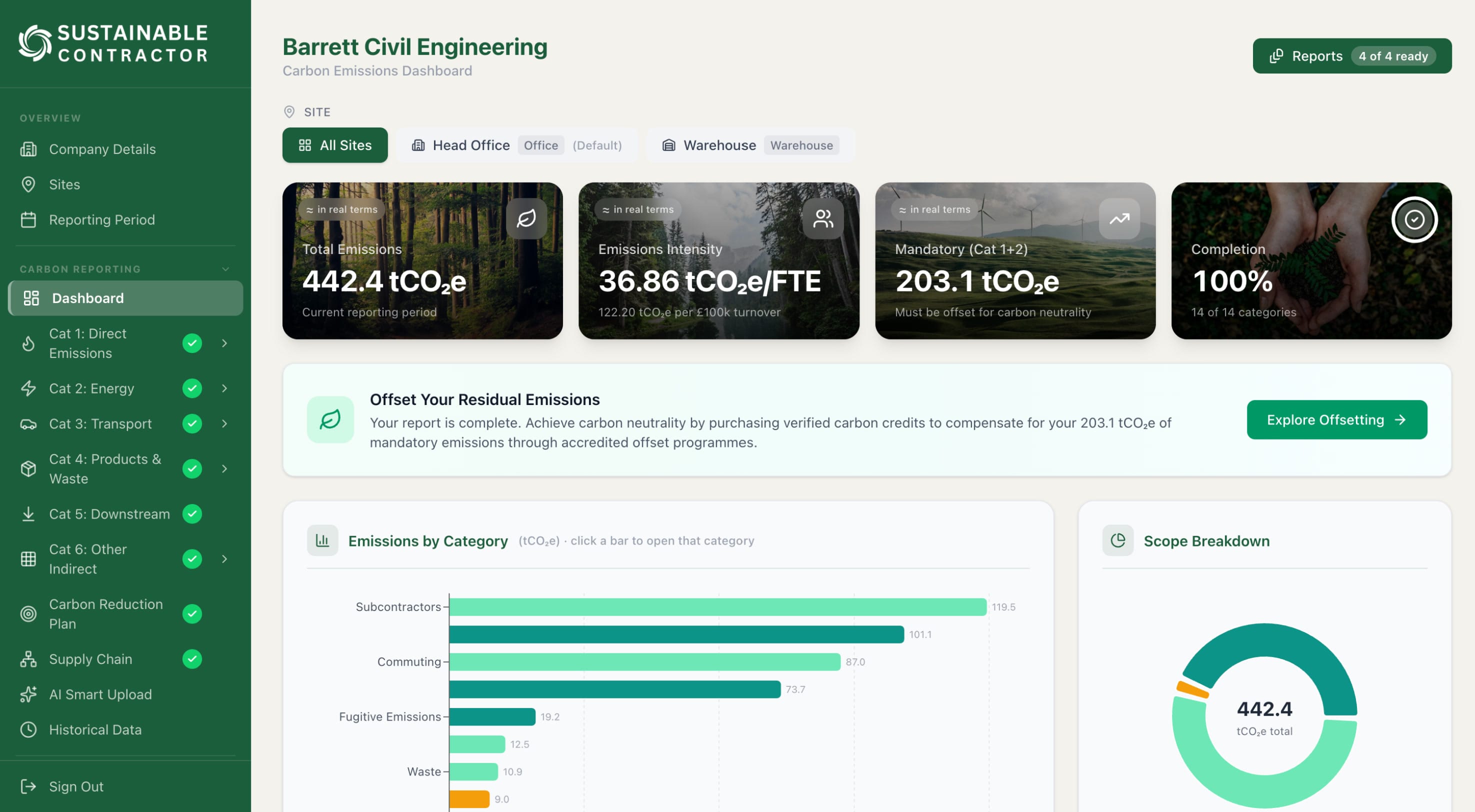
Subcontractor emissions appear in your footprint under category 6.2 Subcontractors, calculated automatically from the supply chain, alongside your own Scope 1, 2 and 3.
- Projects: track a project's carbon on its own, with unlimited subcontractor invitations per project (£250 +VAT each, one-off).
- Reminders: chase missing returns from the platform, one subcontractor at a time or all at once, instead of by spreadsheet and email.
- Coverage: your report shows how many subcontractors have responded, and lists anyone who hasn't in an exclusion log.
Cost
What it costs
Enterprise (£3,490 +VAT a year) includes 10 subcontractor licences and 2 projects every year. On Professional or Enterprise you can add licences at £125 +VAT per licence per year, and projects at £250 +VAT each, one-off.
Invited subcontractors don't pay anything to report to you. If a subcontractor also wants their own Carbon Reduction Plan for their own tenders, they can take a plan of their own. See our page for subcontractors.
Do subcontractors have to pay to report?
No. Each subcontractor you invite uses one of your licences, and their account is free. They only pay if they want a plan of their own, for example to produce their own Carbon Reduction Plan.
How are a subcontractor's emissions split between their clients?
By revenue share. If a third of a subcontractor's turnover came from you, a third of their reported emissions is allocated to your Scope 3. Each allocation comes with an attested allocation statement.
What if a subcontractor won't report?
Send reminders from the Supply Chain page. Until they report, they're left out of your subcontractor total and listed in your report's exclusion log, so you can be open about whose data is in and whose isn't.
Can we track emissions for a single project?
Yes. Projects let you track a scheme's carbon on its own, with unlimited subcontractor invitations per project. Enterprise includes 2 projects every year; extra projects are £250 +VAT each, one-off.
Official guidance
This page summarises the official guidance as it stood on 24 November 2026. It isn't legal advice, so check the source for your own situation.
Related